Somewhere around the fourth read of your own short story, the words stop meaning anything. You know the plot by heart, you can no longer tell whether the joke in the third paragraph is funny or merely familiar, and every sentence starts to look like a sentence you have already fixed. That flatness is not evidence the story is finished. It is evidence you have stopped reading it as a reader and started skimming it as its author. The last pass before submission is a different job from drafting: less sculpting, more inspection. Here is what to check, roughly in the order that saves the most time.
Plot: Look for the Load-Bearing Scenes
Start with the whole shape of the thing, because there is no point polishing a sentence inside a scene that should not be there.
Try to summarise the story in two sentences. If the second sentence keeps turning into "and then… and then…", you probably have more than one story in the same document. Choose the one you care about and cut towards it.
Then ask three blunt questions:
- What does the protagonist want? Not a mood, not a situation — a want they could plausibly fail to get. It should be visible on the first page, even if it is small and slightly shameful.
- Where do they choose? Somewhere in the middle there should be a decision the character cannot unmake. Without it, events happen to someone, which is a report rather than a story.
- What has changed by the last line? Not "she learned something" but something a reader could point at: a relationship shifted, a lie told, a door finally locked.
Check the practical furniture too. Dates, times of day, seasons, the length of a journey, who is in the room and who has left it. Continuity errors are the cheapest way to lose an editor's trust, and they are almost invisible until someone points them out.
Finally, find where the real story begins and consider deleting everything before it. A great many drafts start two paragraphs late.
A scene that can be lifted out without leaving a hole was never holding the story up.
Character: Want, Flaw, Change
Every named character should want something, even if they appear once. The taxi driver wants the fare paid. The sister wants to be asked. Give the minor figures a single specific want and they stop being scenery.
A useful test for voice: take a page of dialogue and cover the speech tags. If you cannot tell who is speaking from the rhythm and vocabulary alone, the characters are interchangeable, however well drawn they feel in your head.
Watch for backstory delivered as a summary. Two lines of information dropped in at the moment it matters beats a paragraph of history nobody asked for. The same goes for description: "her sister, a chiropodist who kept every shoebox in case the original came back into fashion" does more work than a list of features. And if you have written a scene in which someone studies themselves in a mirror, cut it. You will thank yourself.
Dialogue: Enter Late, Leave Early
Most dialogue problems are really editing problems. People in real life say hello, ask after each other's parents and explain what they mean. Characters in good short fiction do very little of that.
- Cut the pleasantries. Start the scene after the greetings, end it before the goodbyes.
- Let people interrupt, deflect and answer the wrong question. Subtext is what happens when nobody says the thing directly.
- Use said and asked almost exclusively. They are invisible on the page, which is exactly what you want. Save the shouting and the opining for the dialogue itself.
- Replace one tag in three with a beat of action — a hand on a kettle, a glance at the door — so the scene keeps moving physically.
- Suggest accent through rhythm and word order rather than phonetic spelling, which tires readers quickly.
The tag-and-beat pass
Print the pages and mark every tag. Delete the adverbs first: if the line reads as angry, "she said angrily" is doing nothing but apologising. Then look at any exchange longer than four lines and ask whether it earns its space. Dialogue that only conveys information the reader already has is the easiest thing in a draft to cut and the hardest to notice.
UK Punctuation and Spelling: The Small Print
If you are submitting to British magazines and publishers, consistency matters more than perfection, but a few conventions will make your manuscript look native to the market.
- Use single quotation marks for speech, with double marks for a quotation inside it: 'She told me, "Not tonight."'
- Keep punctuation inside the closing quote when it belongs to the spoken words. If the sentence continues after the tag, use commas: 'I'll be back,' she said, 'by nine.'
- Verbs ending in -ise (recognise, organise), nouns in -our (colour, favour) and -re (centre, theatre) are standard here, not Americanisms to be avoided.
- Watch the classic pairs: practice (noun) and practise (verb); licence (noun) and license (verb); defence, offence, but defensive, offensive.
- Double the consonant when adding endings to travel, cancel, label, marvel: travelled, cancelled, labelled, marvellous.
- Write dates as 3 May 1998, with no ordinal and no comma. Spell out numbers one to ten unless you have a house style saying otherwise.
- Use spaced en dashes for interruptions — like this — and keep to one style throughout. Three spaced dots for an ellipsis is fine; four is a mistake.
- Italicise titles of books, films and albums; put short story and song titles in single quotes.
Manuscript Formatting: Follow the Rules Exactly
Read the submission guidelines before you format anything, and then follow them to the letter, even where they contradict the advice below. Where a market says nothing, these conventions are safe.
- Set the body in a plain 12-point serif such as Times New Roman or Garamond, double-spaced, with margins of about 2.5cm.
- Indent new paragraphs using your word processor's paragraph settings, never the tab key. Do not add an extra blank line between paragraphs unless you are separating scenes.
- Put your surname, the story title and the page number in the header.
- Include a title page with the story title, your name, contact details and the word count, rounded to the nearest hundred.
- Mark scene breaks with a centred hash symbol or three spaced asterisks, and use the same mark each time.
- Use italics for emphasis rather than underlining, and use them sparingly. Capitals do not count as emphasis.
- Send a clean .docx unless another format is requested. Name the file Surname_Title_Genre.docx so it survives an inbox.
- Strip out tracked changes, comments, coloured text and images. Proofread the covering email as carefully as the story.
One Last Read-Aloud, Then Send It
Before you submit, change the conditions of reading. Print it if you can, or open it on a phone where the line breaks fall differently. Read the whole thing aloud — slowly — and mark every place your tongue stumbles or your attention drifts. Those are the sentences to fix. Read the final page backwards, sentence by sentence, purely to catch typos; it is useless for anything else.
Then leave it for a day, come back, and check the word count against the market's limit. If you are over, cut a whole scene rather than shaving adjectives from twenty paragraphs. If you are under, look for the moment you skipped because it was uncomfortable to write.
Finally, confirm the guidelines one more time — length, genre, whether simultaneous submissions are allowed, what goes in the subject line — and send it. A story sitting in a folder teaches you nothing. A story in an editor's inbox, even a rejected one, teaches you what to do next. Start the next draft the same week.
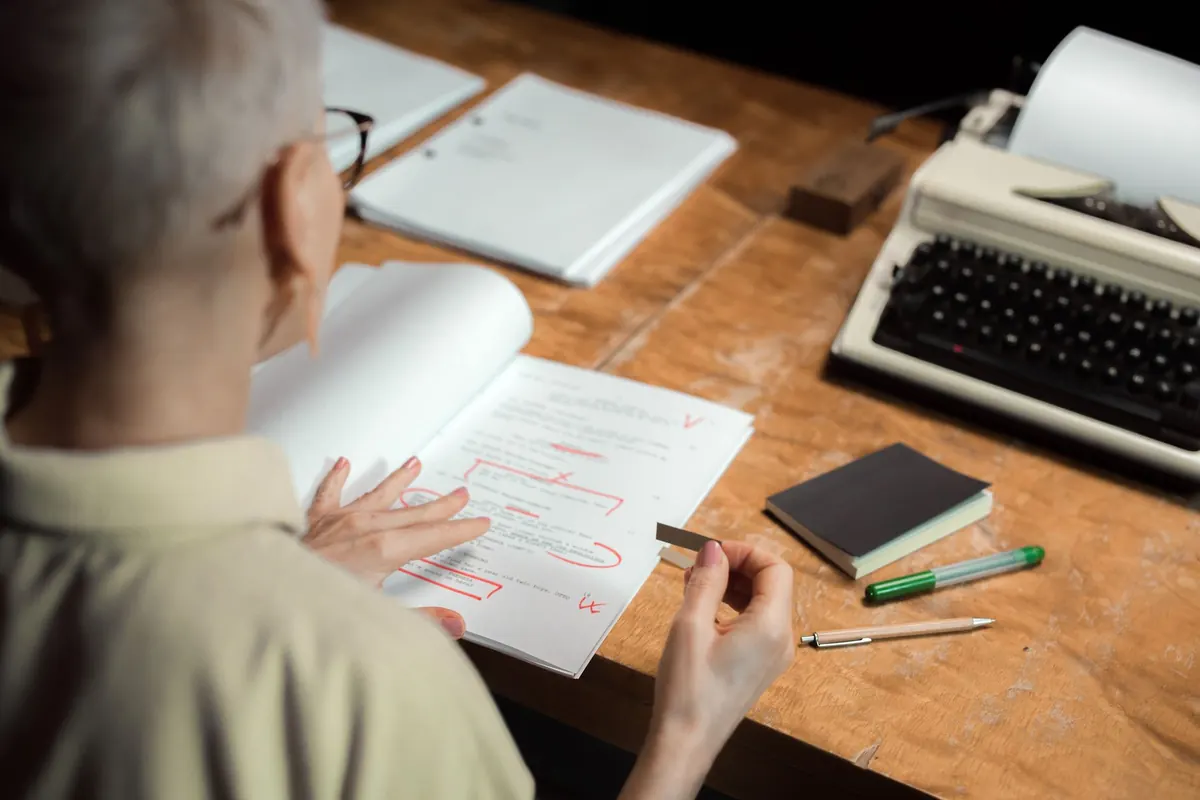
Photo: Ron Lach / Pexels